Episodic Font for Small Business Branding That Feels Just Right
Two weeks ago, I stood in my tiny candle studio—surrounded by soy wax, amber glass jars, and half-printed labels—staring at a label that just didn’t *sing*. It was clean, yes. Legible, absolutely. But it lacked warmth. Personality. That little spark customers remember when they flip through their shelf or scroll past my Instagram post. So I went font-hunting—not for something “trendy,” but for something that felt like *me*: friendly, intentional, quietly joyful. That’s when I found Episodic.
Episodic for Candle Jar Labels and Handmade Product Packaging
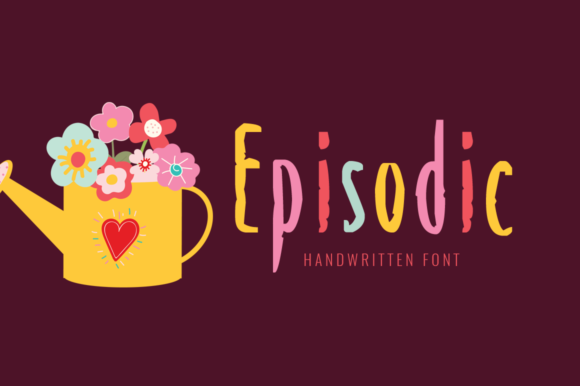
Episodic is a charming and fun display font with an incredible feel—and that’s exactly why it works so well on candle jars, soap wraps, and ceramic tags. Its rounded terminals, gentle curves, and subtle bounce give it a handmade, approachable energy without sacrificing polish. As a small business owner, I needed a font that could hold its own at 16pt on a 2-inch label *and* scale beautifully to a 48pt banner on my Etsy shop header. Episodic delivers both. It’s not a script font, but it has rhythm. Not a serif font, but it carries weight and presence. And because it’s a true display font, it shines brightest where you want attention: the scent name (“Honey & Rain”), the batch number (“No. 07”), or the tiny heart icon beside “Hand-poured in Portland.”
Episodic for Café Menus and Local Business Print Materials
I helped a neighborhood café refresh their laminated menu boards last month—and swapped out their default sans serif for Episodic on section headers like “Morning Brews” and “House Pastries.” Instant lift. Customers noticed. Not because it’s flashy, but because it feels *human*. Episodic adds warmth without clutter, charm without cutesiness. On printed menus, it holds up beautifully—even on matte paper under café lighting. Just keep body text in a clean sans serif (think Montserrat or Inter) for contrast and readability. That pairing? Simple, trustworthy, and unmistakably local.
Episodic for Social Media Graphics and Instagram Story Templates
If your Instagram feed leans warm, earthy, or softly curated, Episodic fits right in. I use it for quote overlays (“Slow down. Breathe. Light one.”), limited-edition drop banners (“New Lavender + Oat Milk Soap — Launching Friday!”), and even as a decorative accent behind product photos. Because Episodic is a display font designed for impact—not long paragraphs—it reads instantly on mobile screens, even at thumbnail size. Pro tip: Use the lightest weight for delicate accents, the regular weight for headlines, and avoid stretching or condensing it—let its natural proportions shine.
Episodic for Logo Design and Boutique Brand Identity Systems
Your logo is often the first thing people see—and first impressions are typography-driven, whether we admit it or not. When I tested Episodic as a primary logo font for a new botanical skincare line, it communicated care, craft, and calm all at once. It’s not overly ornate (so it scales well on stickers and tote bags), and it’s not cold or corporate (so it doesn’t clash with herbal photography or linen textures). As a display font, Episodic works best for short brand names—two to four words max—and pairs beautifully with a neutral serif for taglines (“Small-batch • Plant-powered • Made in California”).
Episodic for Thank-You Cards and Customer-Facing Touchpoints
That little “Thank you for supporting small!” note tucked into every order? I switched it to Episodic. Suddenly, it didn’t feel like an afterthought—it felt like a quiet, personal signature. This font carries tone effortlessly: playful but not childish, elegant but not stiff. Whether printed on kraft cardstock or embedded in a Canva email template, Episodic makes everyday customer touchpoints feel more considered. And yes—it’s fully licensed for commercial use, including physical products, digital templates, and client work. Always double-check the license file, but with Episodic, you’re covered for packaging, merch, web banners, and social ads.
Episodic for Wedding Invitations and Elegant Branding Moments
Even if weddings aren’t your niche, this use case reveals something important: Episodic balances whimsy and refinement in a way few display fonts do. A local florist used it for her “Seasonal Bouquets” brochure—and added a single ligature (like the “fi” or “fl”) for subtle sophistication. No extra plugins, no design degree required. Just open the font file, type, and let Episodic do the work. It’s the kind of fonts choice that makes clients say, “I love how this *feels*—like it was made just for us.”
How to Pair Episodic With Other Fonts for Balanced Branding
You’ll want contrast—and thankfully, Episodic plays well with others. Try it with:
- A modern sans serif (like Poppins or Lato) for body copy, website text, and email newsletters
- A gentle serif (like Playfair Display or Cormorant Garamond) for elegance in print brochures or premium packaging
- A minimal handwritten font (used *sparingly*) for signature lines or hand-lettered accents
Avoid pairing Episodic with other display fonts or overly decorative scripts—it’s meant to be the star, not part of an ensemble cast.
What to Check Before Using Episodic in Your Business
Before dropping Episodic into your next project, peek inside the font files: look for OpenType features like stylistic alternates, ligatures, and multilingual support (especially if you serve bilingual communities). Confirm it includes OTF and TTF formats—and verify the commercial license covers your use case (e.g., selling printable planners, embroidering designs, or licensing templates to other creators). Most importantly: test it where it lives. Print a label. View it on your phone. Hold it beside your current packaging. Does it feel like *more you*? If yes—you’ve found your font.
Because at the end of the day, Episodic isn’t just another set of letters. It’s a quiet upgrade. A confident pause. A little joy, built into every curve. And for small businesses trying to stand out—not shout—Episodic is the display font that helps you be seen, remembered, and trusted—without saying a word.